3D printing is now widely used for making prototypes, custom parts, and complex shapes. But it also creates a lot of waste, including plastic, metal, and ceramic materials. If not handled properly, it can increase costs and harm the environment. So, it is very important to recycle 3D printing waste correctly. How to recycle and handle waste from 3D printing?
General Ideas for Recycling Waste in 3D Printing
Recycling 3D printing waste usually involves several steps, including sorting, crushing, melting, or making pellets again. And the final goal is to turn waste into reusable materials.
- Plastic waste can be sorted by type, like ABS or PLA, and then it is crushed and made into small pellets.
- Ceramic waste is ground into powder, after adding additives, it is fired again to make new products.
- However, recycling metal waste is more complex and requires professional methods. It uses high-temperature melting and careful cleaning to ensure good quality.
Professional Recycling of Metal Waste in 3D Printing
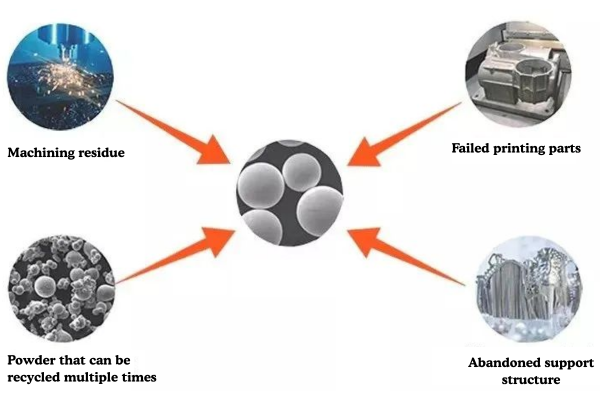
Metal waste is common in 3D printing and often found in industries like aerospace, medical, and automotive. Commonly used metals include stainless steel, titanium alloy, and aluminum alloy. This waste includes failed prints, support structures, and leftover powder. If thrown away directly, it wastes resources and can pollute the environment. So, metal waste must be recycled carefully. Generally, the main steps are removing impurities, melting, and reshaping.
1. Collection and pretreatment are very important.
Metal waste must be sorted and cleaned. Oil, plastic, or other non-metal impurities should be removed. It is worth noting that in printing methods like SLM or EBM, unused metal powder may get dirty or oxidized. It is then sifted or separated using magnets. This step makes sure the melting process works well and gives good quality.
2. Melting is the core step.
The cleaned metal waste is put into a high-temperature furnace. It is heated above its melting point. For example, stainless steel melts at about 1400°C, and titanium alloy above 1600°C, which turns the metal into liquid. During melting, additives or a vacuum can be used to remove oxides and gases, and then improve the metal's purity. After melting, the liquid metal is refined further. Methods like arc furnaces or argon gas treatment can be used. This step makes sure the recycled metal has the same quality as new metal.
3. The metal is reshaped into a usable form.
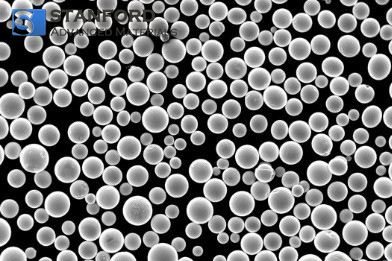
The clean liquid metal can be cast into solid blocks called ingots, or it can be turned into fine powders by atomization. In gas atomization, high-pressure gas breaks the liquid metal into tiny particles. This makes uniform metal powder ready for 3D printing. However, this recycled powder must be tested to check its size and flow. This process allows metal waste to be used again and reduces material costs by 30% to 50%. It also lessens the environmental damage from mining.
It is important to know that recycling metal waste needs special equipment and skills. For example, recycling titanium requires a protective gas to prevent oxidation. So, companies often work with professional recycling plants to make the process safe and efficient.
Handling Other Waste Materials
Beyond metals, plastic and ceramic wastes also require recycling attention. Plastics like PLA and ABS can be crushed and reprocessed into pellets, while ceramics are ground and refired. Though simpler than metal recycling, these processes have limitations—repeated recycling of PLA can degrade its strength, requiring reinforcement additives.
Looking ahead, companies and researchers are finding new ways to recycle. For example, special recycling centers for 3D printing waste are being set up. They use automatic sorting and smart monitoring to work better. Some new companies have developed closed-loop systems. These turn waste directly into printing material. This reduces intermediate steps. Support from governments and new technology will help this field grow. This will lead to greener manufacturing. Stanford Advanced Materials (SAM) is a professional supplier of 3D printing powders. Visit SAM to learn more.
Reference:
Metal 3D Printing Powder Recycling






.png)