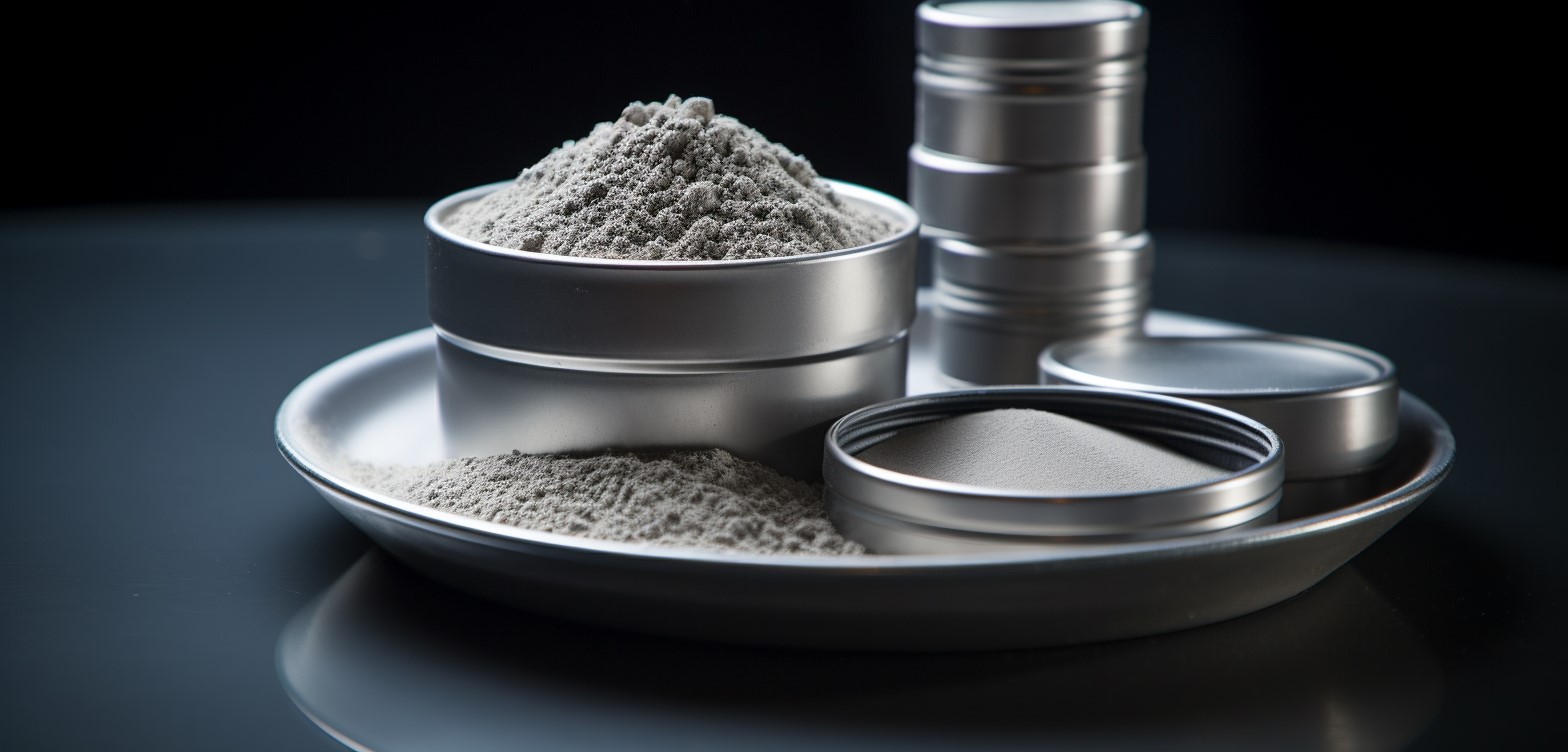
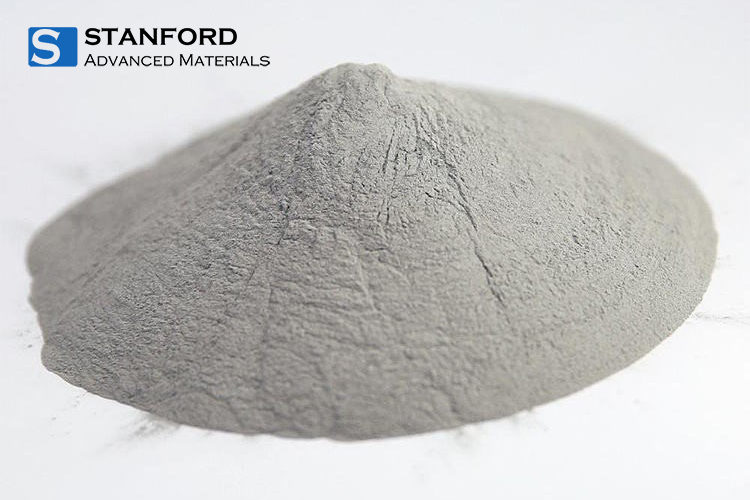
In advanced manufacturing fields like 3D printing and metal injection molding, the properties of metal powder are very important. Among them, "hardness" is a key indicator. It directly affects the wear resistance, strength, and service life of the final product. But how can we know the hardness of a handful of loose powder? Which metal powder is the hardest?
1. Can the Hardness of Metal Powder Be Tested? How?
The direct answer is: Yes, it can be tested, but not with the usual methods for measuring solid metal.
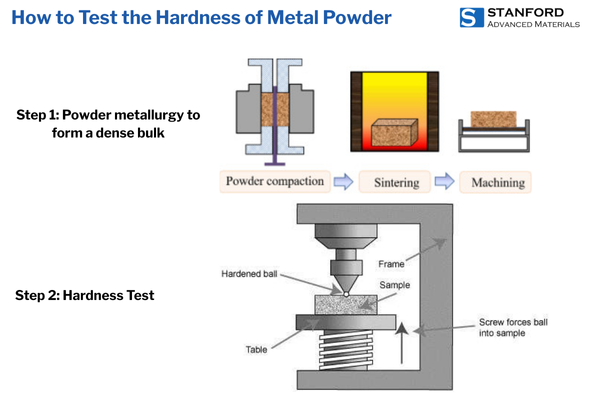
When we talk about the "hardness of metal powder," we usually mean the hardness of the corresponding dense solid metal material. You cannot place a micron-sized powder particle under a Rockwell or Brinell hardness tester. Therefore, scientists and engineers use the following two main methods.
Method 1: Measure the Dense Bulk Material
This is the standard method in industry, also the most common and reliable. The core idea is this: the hardness of a metal powder essentially depends on the material itself. Therefore, we use powder metallurgy processes to turn a specific batch of metal powder into a dense solid block. This block should be close to 100% theoretical density. Then, we use a standard Vickers or Rockwell hardness tester to measure the hardness of this solid block. The value obtained represents the true hardness of the metal powder particles.
Method 2: Microhardness Testing
For scientific research that requires analyzing individual powder particles, Micro-Vickers or Knoop hardness testers are used. Technicians embed the powder in resin, polish it, and then select a flat cross-section of a single particle under a microscope for micro-hardness testing. This method is complex, but it can reveal hardness differences between particles in the same batch.
2. Hardness Ranking: The 10 Hardest Metal Powders
Hardness is often measured using the Vickers hardness (HV) scale. The following list is based on the maximum hardness these metals can achieve after quenching, tempering, or alloying. Please note: pure metals are usually soft, but very high hardness can be achieved through alloying and heat treatment.
|
Rank
|
Metal Powder Name
|
Components
|
Approx. Max. Vickers Hardness (HV)
|
|
1
|
Tungsten Carbide Powder
|
WC, Co
|
2000-3000+
|
|
2
|
High-Speed Steel Powder
|
W, Mo, Cr, V, Co
|
900-1100
|
|
3
|
Maraging Steel Powder
|
Ni, Co, Mo, Ti
|
800-1000
|
|
4
|
Tool Steel Powder
|
Cr, Mo, V
|
700-900
|
|
5
|
Cobalt-Chromium Alloy Powder
|
Co, Cr, W, Mo
|
600-800
|
|
6
|
Titanium Alloy Powder
|
Ti, Al, V
|
350-400
|
|
7
|
Stainless Steel Powder
|
Cr, Ni, Mo
|
300-600
|
|
8
|
Pure Tungsten Powder
|
W
|
300-400
|
|
9
|
Nickel-Based Superalloy Powder
|
Ni, Cr, Co
|
300-500
|
|
10
|
Pure Molybdenum Powder
|
Mo
|
150-250
|
- Ranking 1: Tungsten Carbide Powder. Technically, this is a metal-ceramic composite material. Very hard tungsten carbide particles provide extreme hardness and wear resistance. The metal cobalt acts as a binder and provides toughness. It is a top-level material for making cutting tools, drill bits, and wear-resistant parts.
- Ranking 2: High-Speed Steel Powder. When produced by powder metallurgy, this steel has a more uniform structure. This avoids segregation of elements found in traditional metallurgy. Its high hardness comes from hard carbides formed by elements like tungsten, molybdenum, and vanadium. It retains hardness even under the high temperatures of high-speed cutting, hence the name "high-speed steel."
- Ranking 3: Maraging Steel Powder. This is an ultra-high-strength steel. Its high hardness does not come mainly from carbon. Instead, elements like nickel, cobalt, molybdenum, and titanium form intermetallic compounds during a low-temperature "aging" treatment. This process gives very high hardness while also maintaining excellent toughness.
- The Hardness No.1 Among Pure Metal Powder: Tungsten Powder. If we strictly limit the scope to pure metal powders consisting of a single element, then the hardest is tungsten powder. Tungsten has the highest melting point (3422°C) of all metallic elements.
Important Note: This ranking is for reference only. Actual hardness depends greatly on powder production process, alloy composition, heat treatment, and densification level.
3. Frequently Asked Questions
Q1: Which is harder, aluminum powder or copper powder?
A: Copper powder is harder. Pure aluminum has a hardness of about 25 HV. Pure copper has a hardness of about 40 HV. Even common aluminum alloys (like AlSi10Mg, hardness about 100-120 HV) are usually less hard than common copper alloys (like bronze, which can reach over 150-200 HV).
Q2: Why do metal powders usually need to be made into alloys to become hard?
A: In pure metals, the atoms are arranged in an orderly way. The layers can slide over each other easily, and this makes them soft. Adding other alloying elements (like carbon, vanadium, chromium) creates solid solutions or hard intermetallic compound particles. These particles block the movement of dislocations. Dislocation movement is what allows plastic deformation in metals. Blocking this movement makes the material stronger and harder. It is like scattering sand on a smooth ice surface, then it becomes harder to walk on.
Q3: If a powder feels "smooth" to the touch, is it soft?
A: Not necessarily. This is a common misunderstanding. The "smooth" feeling is usually related to the particle shape and size of the powder. Spherical powder flows well and feels smooth. But each little sphere itself could be made of very hard tool steel. Irregularly shaped powder particles can get stuck together. They might feel "rough." But the material itself might be a softer metal. The touch feeling cannot directly show the hardness of the material itself.
Q4: Is hardness the only factor when choosing a metal powder?
A: Absolutely not. Hardness is very important. But it must be considered together with other properties. For example:
- Toughness: The material's ability to resist impact. High hardness often comes with low toughness.
- Strength: The material's ability to resist deformation and breaking.
- Corrosion Resistance: Its stability in specific environments.
- Processability: The powder's flowability, apparent density, etc. These directly affect the success of 3D printing or pressing.
Choosing the right metal powder is an art. It is about finding the best balance between hardness, toughness, cost, and application requirements. For more product information, please contact Stanford Advanced Materials.