Aluminum powder is an important industrial material. It is lightweight, conducts electricity well. It is also highly reactive. Because of these properties, it is used in many fields. These include chemicals, metallurgy, refractory materials, coatings, and 3D printing.
Different applications need different types of aluminum powder. They require specific particle sizes, shapes, and purity levels. Choosing the right production method is very important. This article explains four main production processes. These are atomization, ball milling, jet milling, and vapor deposition.
1. Atomization Method: The Most Common Technology
Atomization is the most widely used method for making aluminum powder. It has the highest production volume.
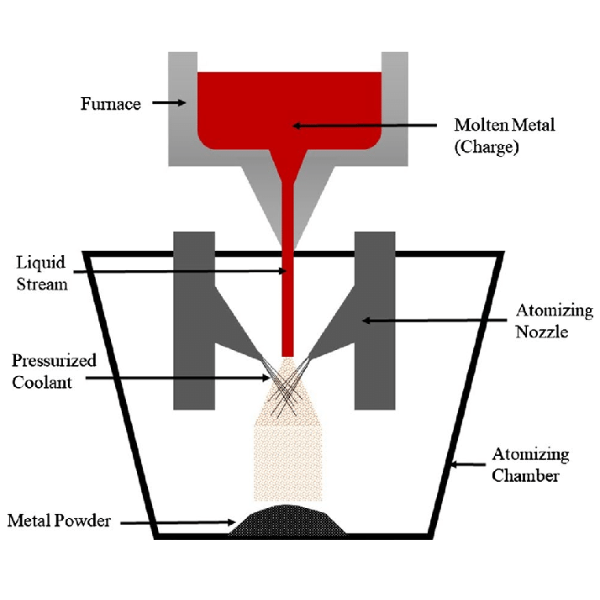
Fig 1. Schematic of the working principle of the powder atomization process.[1]
The basic idea is simple. High-purity aluminum ingots are melted in a furnace. Sometimes, other elements are added to make an alloy. Then the liquid aluminum flows through a guide tube to a nozzle. At the nozzle, a high-pressure jet of medium hits the liquid stream. The medium can be air, nitrogen, argon, or water. This impact breaks the stream into millions of tiny droplets. These droplets fall and solidify. They are collected as aluminum powder.
There are two main types of atomization, based on the medium used:
- Gas Atomization: This method uses high-pressure inert gas. Nitrogen or argon a common gases. The aluminum powder made this way is very spherical. It has a clean surface with little oxidation. It also flows very well. This powder is ideal for 3D printing and powder metallurgy. A downside is that it uses more energy. The powder particles are also not super fine.
- Water Atomization: This method uses a high-pressure water jet. Water cools the droplets much faster than gas. The resulting aluminum powder particles are irregular in shape. They look like small potatoes. The surface is also rough. This gives them a large surface area. This powder is very reactive. It is good for pyrotechnics, thermite, and chemical reactions. It is often cheaper than gas-atomized powder.
Atomization is the standard method for large-scale production. It can make powders in different shapes, from spherical to irregular. But it is difficult to make very fine, nano powder directly with this method.
This article provides a more detailed comparison of gas atomization versus water atomization: Gas Atomization vs Water Atomization vs Plasma Atomization: What is the Difference
2. Ball Milling Method for Flake Aluminum Powder
Ball milling is a physical grinding process. It is the traditional way to make flake aluminum powder. The goal is not to make particles smaller. Instead, it is to flatten them.
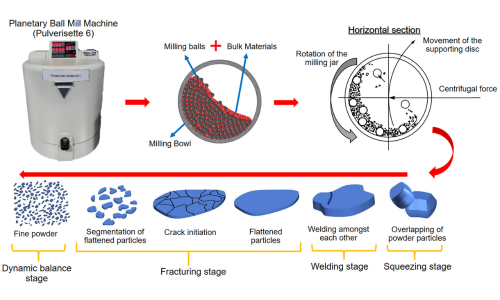
Fig 2. Principles of the ball milling method for reducing powder particle size[2]
Spherical aluminum powder from atomization is used as the raw material. It is put into a ball mill together with a lubricant, like stearic acid. Grinding media, like ceramic or steel balls, are also added. The ball mill rotates. The grinding media hit, roll over, and rub against the aluminum particles. The aluminum is ductile. Because of this, the spherical particles get hammered and flattened. They turn into thin flakes. These flakes can be microns or even nanometers thick.
Ball milling is the best way to make flake aluminum powder. The final product has great coverage and reflectivity. It creates a metallic shine effect in paints. This makes it perfect for metallic pigments and anti-corrosion coatings. A disadvantage is that the process is slow. It also uses a lot of energy. The flake powder does not flow well. It is not suitable for applications that need spherical powder.
3. Jet Milling Method for Very Fine Spherical Aluminum Powder
Jet milling is also called fluidized bed jet milling. It is a method to make very fine spherical aluminum powder. It can make powder with a median particle size below 10 microns. It uses the energy from supersonic gas streams.
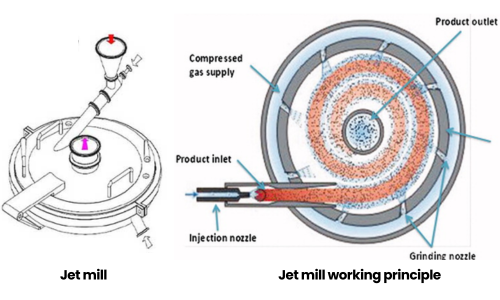
Fig 3. Jet mill working principle[3]
Coarser aluminum powder is used as the feed material. It is fed into a special grinding chamber. Inside the chamber, high-pressure gas jets create a swirling vortex. The gas is usually air or nitrogen. The particles are accelerated in this vortex. They collide with each other at high speed and break apart. The main force is particle-to-particle impact. There is little contact with the machine walls, which keeps the powder very pure. The particles also remain mostly spherical. A classifier inside the mill checks the particle size. Fine powder that is ready leaves the mill. And coarse powder is sent back for more grinding.
Jet milling is excellent for making fine, high-purity, spherical powder. It is efficient and causes little contamination. It is used for high-end ceramics, advanced 3D printing, and fine chemicals.
4. Vapor Deposition for Nano Aluminum Powder
Vapor deposition is an advanced technology. It is used to make nano-sized aluminum powder. The principle is completely different from the other methods. It is based on physical vapor deposition (PVD).
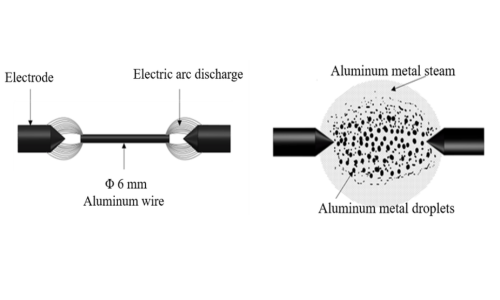
Fig 4. Vapor Deposition for Nano Aluminum Powder[4]
A solid aluminum source is placed in a chamber. The chamber is under a high vacuum or filled with inert gas. The aluminum is heated until it evaporates. Heating can be done with an electron beam, plasma arc, or electric current, which creates a vapor of aluminum atoms. The atoms rise and meet a cooler environment. They then condense and form tiny nuclei. These nuclei grow into nano-scale spherical powder. The process must be controlled very carefully. This prevents the particles from growing too big or exploding.
This method makes a very pure nano aluminum powder. The powder has no defects and an even size distribution. It is used in advanced applications. These include rocket propellants, high-performance catalysts, and aerospace materials. The equipment is very expensive. The production volume is very low. The cost is very high. Because of this, it is mostly used in labs and for special high-tech needs.
Tips: Many people confuse vapor deposition for films with its use for creating nano-powders. This analogy clarifies the difference: Making a thin film is like breathing on a cold window, and vapor condenses onto the glass (substrate). In contrast, generating nano-powder is like steam condensing in cold air, then it forms a mist of particles.
For more product information, please contact Stanford Advanced Materials: Get A Quote
Frequently Asked Questions (FAQ)
1. What is the most common type of aluminum powder?
Atomized aluminum powder is the most common. It is used in the largest quantities for industries like 3D printing and chemicals.
2. Why is flake aluminum powder used in paints?
Flake powder creates a shielding effect. The flakes overlap like roof tiles. And water and air are blocked from reaching the surface. Of course, it also gives a shiny, metallic look.
3. Can I use flake aluminum powder for 3D printing?
No, you cannot. 3D printing needs powder that flows freely. Flake powder does not flow, and it clumps together. Spherical powder from atomization or jet milling is used for 3D printing.
4. Which method produces the finest aluminum powder?
Vapor deposition produces the finest powder. It makes particles at the nano-scale. Jet milling can make a very fine micro-sized powder.
5. Is aluminum powder dangerous?
Yes, fine aluminum powder can be flammable or explosive, so it must be handled carefully. It should be stored away from heat and sparks. Production often happens in an inert gas to prevent fires.
6. What is the difference between gas and water atomization?
Gas atomization uses air or nitrogen. It makes spherical, smooth powder. While water atomization uses water, it makes irregular, rough powder that is more reactive.
7. Why is spherical powder important for powder metallurgy?
Spherical powder packs together densely. It flows evenly into a mold. This helps create metal parts with high strength and few voids.
[1] Al-Shataif, Yaser & S., Sivasankaran & Al-Mufadi, Fahad & Alaboodi, Abdulaziz & Ammar, Hany. (2019). Manufacturing Methods, Microstructural and Mechanical Properties Evolutions of High-Entropy Alloys: A Review. Metals and Materials International. 26. 3. 10.1007/s12540-019-00565-z.
[2] Wei, L.K.; Abd Rahim, S.Z.; Al Bakri Abdullah, M.M.; Yin, A.T.M.; Ghazali, M.F.; Omar, M.F.; Nemeș, O.; Sandu, A.V.; Vizureanu, P.; Abdellah, A.E.-h. Producing Metal Powder from Machining Chips Using Ball Milling Process: A Review. Materials 2023, 16, 4635. https://doi.org/10.3390/ma16134635
[3] Nakach, M., Authelin, J. R., Corsini, C., & Gianola, G. (2019). Jet milling industrialization of sticky active pharmaceutical ingredient using quality-by-design approach. Pharmaceutical Development and Technology, 24(7), 849–863. https://doi.org/10.1080/10837450.2019.1608449
[4] Wu, X.; Ren, H.; Jiao, Q. Improved Combustion Performance of Fluororubber-Coated Micro-Nano Composite Aluminum Powder. Metals 2023, 13, 556. https://doi.org/10.3390/met13030556







.jpg)