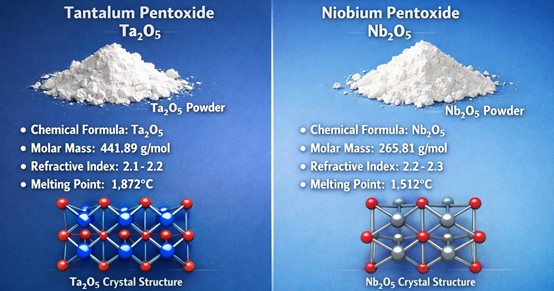
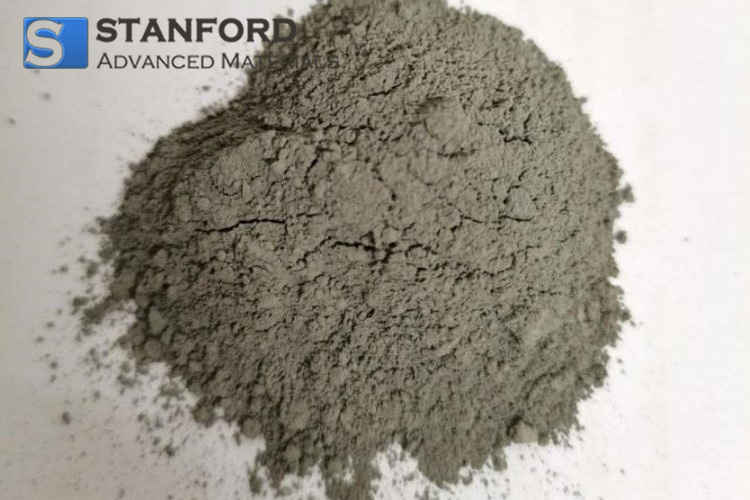
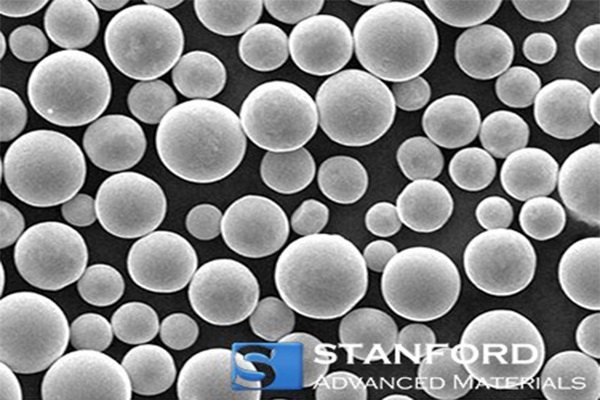
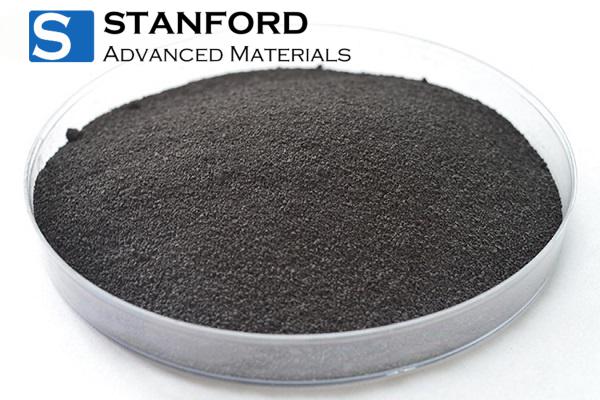
Tantalum and niobium are transition metals in the same group, and therefore chemically similar. Simultaneously, tantalum pentoxide (Ta2O5) and niobium pentoxide (Nb2O5), two high-performance ceramic oxides, are frequently mentioned together because of the similarity of their chemical properties. Although sharing a few characteristics, their differences in chemical reactivity and physical properties have led to quite different applications.
Comparative Properties between Tantalum Pentoxide and Niobium Pentoxide
Their reactivity is governed by their high thermodynamic stability, but key distinctions exist.
Table 1. Key physical and functional differences between tantalum pentoxide and niobium pentoxide.
|
Property
|
Tantalum Pentoxide (Ta₂O₅)
|
Niobium Pentoxide (Nb₂O₅)
|
|
Density
|
High (~8.2 g/cm³)
|
Moderate (~4.6 g/cm³)
|
|
Dielectric Constant (κ)
|
High, 25-50 (amorphous thin films)
|
Moderate, ~40-60 (crystalline), but less stable in thin films
|
|
Band Gap
|
Wider (~4.0 eV)
|
Narrower (~3.4 eV)
|
|
Acidic Sites
|
Weak Lewis acidity
|
Stronger intrinsic Lewis and Brønsted acidity
|
To begin with, taking into consideration their fundamental physical characteristics, the density of tantalum pentoxide is very high, estimated to be about 8.2 g/cm³, whereas the density of niobium pentoxide is much lower, approximately 4.6 g/cm³. Therefore, based on their higher density, the use of tantalum oxide will be very beneficial.
However, the difference that matters the most is in terms of their electrical properties. Tantalum pentoxide has a fixed, though high, dielectric constant in its amorphous thin film, which is normally in the range of 25 to 50. However, the unique property that has made it the only preferred choice for the production of high-density tantalum capacitors is the fixed, high dielectric constant value coupled with the low leakage current property of the thin films. Niobium pentoxide, on the contrary, although the same high dielectric constant value in its crystalline form, has lesser stability in thin film form when compared to that of tantalum pentoxide.
Regarding optical and electronic properties, tantalum pentoxide has a higher band gap of approximately 4.0 eV due to its high insulating properties. Niobium pentoxides have lower band gaps of approximately 3.4 eV, which enhances the absorption capacity of visible light—a property directly linked to its application as a photocatalytic material.
An important difference at the level of chemical properties regards the quality of surface acidity. Niobium pentoxide has stronger intrinsic Lewis and Brönsted acidity, which directly translates to its enhanced catalytic activity, thus its preference in an acid-catalyzed reaction. Tantalum pentoxide is comparatively weaker in this respect.
Comparative Applications between Tantalum Pentoxide and Niobium Pentoxide
Tantalum pentoxide (Ta₂O₅) and niobium pentoxide (Nb₂O₅) differ fundamentally in their physical and functional properties, and these differences directly dictate where each material is used.
1. Electronics & Optics
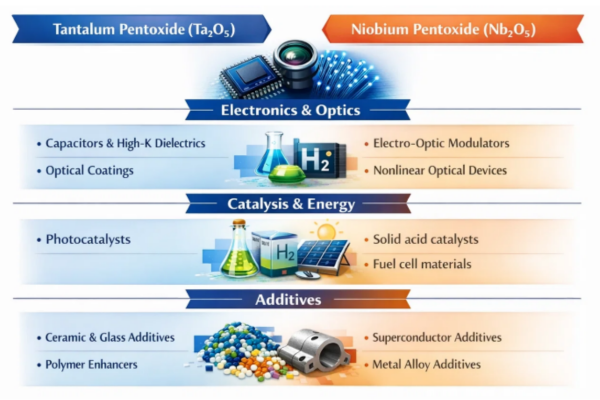
Tantalum pentoxide is currently the undisputed champion in both solid electrolyte tantalum capacitors and high-index, low-loss laser and lens coatings. The ability to provide a high κ amorphous dielectric layer on a macroscopically large surface area tantalum anode in Ta₂O₅ is paramount.
Niobium pentoxide is a substitute used in the making of niobium capacitors that is somewhat less expensive but performs equally well, albeit with a higher leakage current. The main field it is entering is that of new-generation batteries. Coating the anode of lithium-ion batteries (with a TiNb₂O₇ layer, for example) improves fast charging and longevity. It is also a part of the making of nonlinear optical crystals based on niobate.
2. Catalysis & Energy
Tantalum pentoxide is appropriate for specific photocatalysts, for example, water splitting, because of the appropriate position of the band and its stability.
Niobium pentoxide is an extremely promising solid acid catalyst. The surface acidity sites of Nb₂O₅ are useful for biomass transformations (e.g., fructose to HMF) and biodiesel synthesis. Nb₂O₅ as the catalyst support for Pt in fuel cells improves the metal dispersion and stability because of strong metal-support interaction.
3. Additives
Both act as grain growth inhibitors in specialized sintered ceramics. Niobium pentoxide is crucial in niobium-stabilized stainless steels, added as ferroniobium, imparting corrosion resistance at high temperatures.
Conclusion
Thanks to its stable high dielectric performance and excellent insulating properties, Ta₂O₅ dominates markets requiring high‑reliability electronic components and optical coatings. In contrast, Nb₂O₅ leverages its functional reactivity and surface acidity to carve out important roles in catalysis, energy materials, and cost‑sensitive electronics. Stanford Advanced Materials (SAM) offers both tantalum-based and niobium-based powders with customizable purity and particle sizes.