The direct manufacturing of functional metal parts using additive manufacturing technology has become a significant development trend. There are various types of metal 3D printing processes capable of producing metal parts directly, including Selective Laser Sintering (SLS), Direct Metal Laser Sintering (DMLS), Selective Laser Melting (SLM), Laser Engineered Net Shaping (LENS), and Electron Beam Melting (EBM). Currently, SLM and EBM are the two dominant metal 3D printing processes. So, what are the key differences between them?
Selective Laser Melting (SLM)
Selective Laser Melting (SLM) 3D printing technology uses a high-power laser as its energy source to directly form metal parts by completely melting metal powder. This requires a laser beam with high power density.
Selective Laser Melting Process
During the process, a horizontal recoater first spreads a uniform layer of metal powder onto the substrate within the build chamber.
The laser beam then selectively melts the powder on the substrate according to the contour data of the current layer, forming that layer's shape.
After a layer is completed, the build platform lowers by the thickness of one layer, the recoater applies a new layer of powder, and the machine loads the contour data for the next layer.
This layer-by-layer stacking continues until the entire part is fabricated.
The entire process takes place in a build chamber that is either evacuated or filled with an inert gas to prevent oxidation or other reactions between the metal and gases at high temperatures.
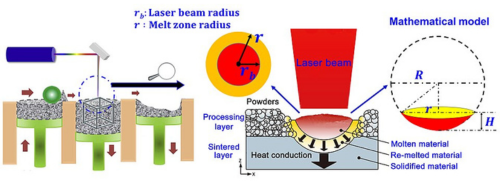
Fig 1. Schematic of selective laser melting and the heat transfer in molten pool, from Wikipedia
Advantages of Selective Laser Melting
1. Directly manufactures functional metal parts without intermediate steps.
2. Excellent beam quality allows for a finely focused spot, enabling the direct production of parts with relatively high dimensional accuracy and good surface finish.
3. The metal powder is fully melted, resulting in parts with a metallurgically bonded microstructure, high density, and good mechanical properties, often without the need for post-processing.
4. The powder material can be a single material or a multi-component material, and the raw material does not require special preparation.
5. Capable of directly manufacturing parts with complex geometries.
6. Particularly suitable for manufacturing single parts or small batches. Selective Laser Sintering (SLS) parts tend to have lower density and poorer mechanical properties. Electron Beam Melting (EBM) and Laser Cladding often struggle to achieve high dimensional accuracy. In comparison, SLM technology can produce parts with metallurgical bonding, dense microstructure, high dimensional accuracy, and good mechanical properties, making it a major research focus and development trend in rapid prototyping in recent years.
Electron Beam Melting (EBM)
Electron Beam Melting (EBM) 3D printing is an additive manufacturing technology that uses a high-energy electron beam to melt metal powder layer by layer in a high-vacuum environment.
Electron Beam Melting Process
The process is as follows:
First, a layer of metal powder is spread on the build platform.
Then, under computer control, the electron beam selectively scans the powder layer according to the cross-sectional contour data, melting it and fusing it to the previously solidified layer.
The steps of powder spreading and melting are repeated layer by layer until the part is fully formed.
Finally, the excess powder is removed to obtain the desired 3D metal part.
During the process, scan signals from the host computer are converted from digital to analog, amplified, and sent to deflection coils. The electron beam is precisely deflected by the magnetic field generated by the corresponding deflection voltage, enabling selective melting of the powder.
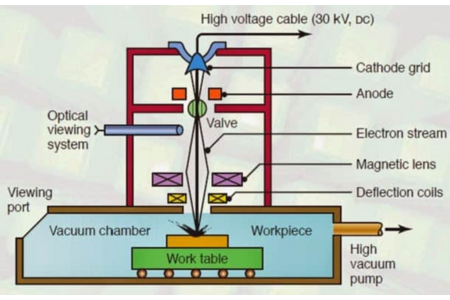
Fig 2. Electron beam machining Diagram, from Learn Mech
Advantages of Electron Beam Melting Technology
Electron Beam Direct Metal Forming technology uses a high-energy electron beam as the heat source, and the scanning process is achieved by controlling magnetic deflection coils. Since electromagnetic deflection is used, this method has no mechanical inertia and responds rapidly. Furthermore, the EBM process operates in a vacuum environment, effectively preventing oxidation of the metal powder during liquid phase sintering or melting.
Compared to lasers, electron beams offer advantages such as higher energy efficiency, greater penetration depth, more stable material absorption rates, and lower operating and maintenance costs. EBM technology features high build efficiency, low residual stress in parts, generally requires no additional support structures during the build, and produces parts with a denser microstructure.
The deflection and focusing of the electron beam are both achieved magnetically. By adjusting electrical signals, the beam path and focus can be controlled quickly and precisely. This entire process occurs within a vacuum and magnetic field, making it less susceptible to interference from factors like metal vapor deposition and resulting in high stability and controllability.
SLM vs. EBM: Equipment Characteristics Comparison
1. Different Heat Sources. SLM uses a laser as its heat source, while EBM uses an electron beam. Metals reflect laser light to varying degrees, so SLM's energy utilization efficiency is generally lower than EBM's. However, SLM's beam spot is typically smaller than EBM's, which is more conducive to forming fine part features and complex geometries. EBM's higher energy efficiency makes it more suitable for manufacturing parts from highly conductive metals, high-temperature alloys, and high-melting-point metals.
2. Different Build Environments. SLM technology performs melting in an inert gas atmosphere, while EBM operates in a vacuum. Comparatively, the vacuum environment of EBM is more effective in avoiding oxidation and oxygen pick-up during part fabrication.
3. Different Build Temperatures. SLM can preheat up to about 300°C at most. EBM technology uses the electron beam itself to scan and preheat each layer of powder, allowing parts to be built within a temperature range of approximately 600–1200°C. This significantly reduces residual stress in the fabricated parts.
4. Different Part Characteristics. Due to the different working principles of the equipment, the characteristics of the manufactured parts also show distinct differences. Overall, SLM-produced parts generally have better surface quality and more accurate fine structural details, making them very suitable for applications in mold manufacturing. However, in some medical implant fields, the rougher surface of EBM parts can be more desirable. Additionally, EBM parts tend to experience less distortion and stress cracking.
5. Production Considerations. EBM build rates are generally much higher than SLM's, making it more suitable for larger batch production.
|
Comparison Dimension
|
SLM (Selective Laser Melting)
|
EBM (Electron Beam Melting)
|
|
Heat Source
|
Laser
|
Electron Beam
|
|
Build Environment
|
Inert gas atmosphere
|
Vacuum environment
|
|
Build Temperature
|
Preheats up to ~300°C max
|
Builds within ~600–1200°C
|
|
Part Characteristics
|
Better surface quality, accurate fine details
|
Rougher surface, lower residual stress and distortion
|
|
Production Considerations
|
More suitable for low-volume, high-precision production
|
More suitable for large-batch production
|
SLM vs. EBM: Metal Powder Requirements Comparison
Although both are based on the powder bed fusion principle, their requirements for metal powder differ significantly due to the fundamental difference in their energy sources—one uses light (photons), the other uses charged particles—and their vastly different working environments.
What are Metal Powders Suitable for Selective Laser Melting
For Selective Laser Melting (SLM), the powder's core task is to efficiently absorb photons. The powder must efficiently absorb laser light of a specific wavelength, making the material's optical properties crucial. Metals with very high reflectivity, like copper, posed a significant challenge in the early days of SLM. Furthermore, the entire process requires a pure inert gas atmosphere to isolate oxygen and prevent oxidation and embrittlement. This demands that the powder itself has very low oxygen content. The particles are also typically finer and more spherical to ensure uniform powder spreading and adapt to the laser's precision processing.
What are Metal Powders Suitable for Electron Beam Melting
For Electron Beam Melting (EBM), the rules are completely different. An electron beam is a stream of high-speed charged particles. Therefore, the powder must first be a good electrical conductor; otherwise, the electron beam cannot effectively transfer its energy. The build environment is a high vacuum. While this perfectly prevents oxidation, it also excludes materials like aluminum and magnesium alloys, which can vaporize easily in a vacuum. Consequently, EBM excels at processing conductive, refractory metals that are stable in vacuum, such as titanium and tantalum. Due to its process characteristics (vacuum, preheating, high-energy fast scanning), it can use coarser powder with better flowability and has a higher tolerance for powder particle size distribution.
|
Characteristic
|
Powder for SLM
|
Powder for EBM
|
|
Particle Size
|
Typically 15-45 micrometers
|
Typically 45-105 micrometers
|
|
Material Range
|
- Aluminum Alloys
- Stainless Steels
- Titanium Alloys
- Nickel-based Superalloys
- Tool Steels
- Cobalt-Chromium Alloys
- Precious Metals
|
- Pure Titanium & Titanium Alloys (e.g., Ti6Al4V)
- Tantalum
- Niobium
- Zirconium Alloys
- Nickel-based Superalloys
- Cobalt-Chromium Alloys
|
|
Key Requirements
|
1. Efficient absorption of specific laser wavelength
2. Extremely low oxygen content
|
1. Electrical Conductivity
2. Vacuum Stability (low volatility)
|
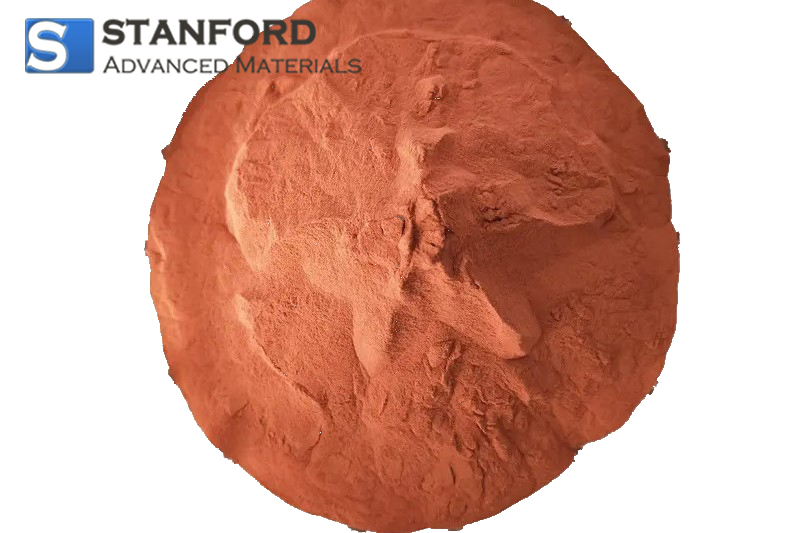
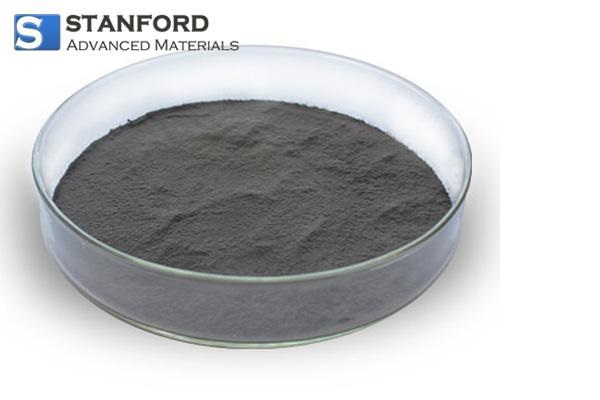
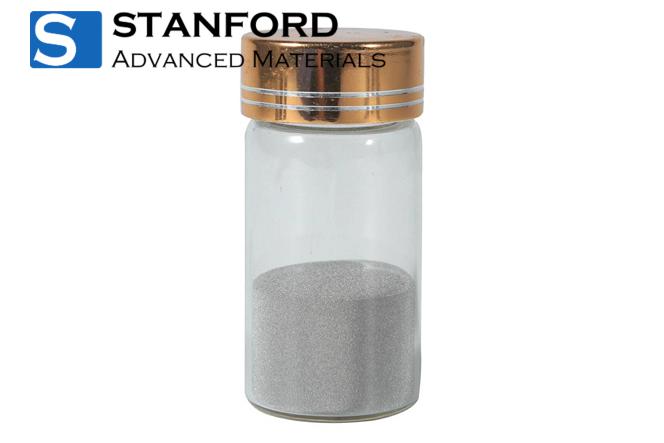
Stanford Advanced Materials (SAM) offers a variety of 3D printing metal powders, including spherical powders, available in sizes.
Conclusion
From the comparative analysis above, it is clear that both processes currently have their own distinct characteristics and advantages, making them suitable for application in different fields. SLM holds an advantage in part detail, feature resolution, and geometric complexity. EBM, on the other hand, is better at controlling residual stress in parts, and parts made with EBM technology often do not require heat treatment.