Molybdenum carbide (Mo₂C) powderr has been making waves in materials science lately. It's a go‑to material for traditional hard alloys, and now it's stepping into the spotlight in cutting‑edge areas like clean energy and catalysis. We've pulled together some of the most common questions from our readers — here's what you're asking.
1. Is Molybdenum Carbide Powder A 2D Material?
Not quite—but it can be turned into one.
When produced via traditional high‑temperature methods, molybdenum carbide powder typically forms 3D particles—either micron‑sized or nano‑sized. That's not truly 2D. Real 2D materials, think graphene or MXenes, are only an atom or two thick.
Here's the cool part, though: scientists have now created 2D molybdenum carbide nanosheets. These sheets have a layered structure like graphene, exhibit unique electrical properties, and offer much greater surface area. In electrochemical catalysis, they tend to work better than the standard 3D particles.
So, while most molybdenum carbide powder you can buy is still 3D, the 2D version is becoming a big deal in research—and could change how we use this material down the road.
2. What are the Catalytic Properties of Molybdenum Carbide Powder?
This is currently its most studied and promising feature.
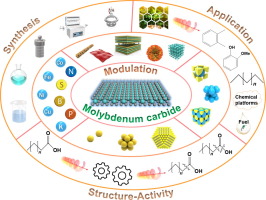
Molybdenum carbide as catalyst in biomass derivatives conversion[1]
Molybdenum carbide is often called a "platinum-like catalyst" because it shows catalytic activity close to that of precious metal platinum in certain reactions—at a much lower cost. Its key catalytic characteristics include:
- Great at hydrogen reactions: It really shines in the hydrogen evolution reaction (HER), which is key to making green hydrogen through water splitting.
- Handles impurities well: Unlike some pricey catalysts, it's less sensitive to poisons like sulfur.
- Easy to tweak: You can fine‑tune its activity and stability by changing its shape, particle size, or mixing it with other materials (like nitrogen‑doped carbon).
- Where it's used: Mainly in electrocatalysis (water splitting, oxygen reduction), thermal catalysis (hydrodesulfurization, methane reforming), and photocatalysis.
3. Is Molybdenum Carbide Powder Conductive?
Yes, absolutely, it's actually a pretty good conductor.
Molybdenum carbide powder is a metallic carbide, and it's not like insulating materials such as alumina. Instead, its crystal structure combines both metallic and covalent bonds, so it has free electrons that can move around. This gives it electrical and thermal conductivity similar to metals, which makes Mo₂C especially useful in electrochemical applications—where you need fast electron transfer for high‑efficiency catalysis.
4. How Hard is Molybdenum Carbide Powder?
Extremely hard—molybdenum carbide powder belongs to the family of ultra-hard materials.
Its micro-Vickers hardness typically ranges between 1500–2000 HV. For comparison:
- Hard alloy tool materials (WC-Co): ~1500–1800 HV
- Quenched tool steel: ~800–900 HV
- Window glass: ~550 HV
Thanks to its high hardness, high melting point (~2690°C), and good wear resistance, Molybdenum carbide is traditionally used as an additive in hard alloys to improve red hardness (ability to retain hardness at high temperatures) or to create wear-resistant coatings.
5. How is Molybdenum Carbide Powder Produced?
There are several methods, each yielding powder with different characteristics.
The most common is direct carburization. Molybdenum powder or oxide (e.g., MoO₃) is mixed with a carbon source (carbon black, graphite) and heated at high temperatures (1200–1500°C) for an extended time in an inert or reducing atmosphere (H₂/Ar) to form Mo₂C.
Chemical vapor deposition (CVD) can produce high-purity thin films or powders with controlled morphologies.
Temperature-programmed reduction (TPR) is used to create high-surface-area nanocatalysts by carefully controlling the heating profile while reducing a molybdenum precursor with hydrocarbon gases (e.g., CH₄/H₂).
Mechanical alloying uses high-energy ball milling to trigger solid-state reactions between Mo and C, though achieving a pure phase is challenging.
6. Is Molybdenum Carbide Powder Toxic?
It's generally considered low in toxicity—but safe handling is still important.
Current research suggests Molybdenum carbide has much lower cytotoxicity than some transition metal oxides and shows relatively good biocompatibility. The main risk comes from its powder form: fine particles can irritate the respiratory tract if inhaled, and long-term, high-level exposure may potentially lead to pneumoconiosis.
Safe handling guidelines:
- Wear an N95 or higher-grade dust mask, safety goggles, and gloves.
- Work in a fume hood or well-ventilated area to avoid dust spread.
- Store sealed in a dry place away from strong acids and oxidizers.
- Dispose as general industrial solid waste—do not discard casually.
In the End
Did this article cover what you were curious about? If not, leave a comment below—we may update this in the future.
Stanford Advanced Materials (SAM) specializes in supplying high-quality metal and alloy powders. Send us an inquiry for more information.
[1] Xiangze Du, Rui Zhang, Dan Li, Changwei Hu, Hermenegildo Garcia,Molybdenum carbide as catalyst in biomass derivatives conversion,Journal of Energy Chemistry,Volume 73,2022,Pages 68-87,ISSN 2095-4956,https://doi.org/10.1016/j.jechem.2022.05.014.






.png)

 Oxide Powder (1).jpg)
.jpg)