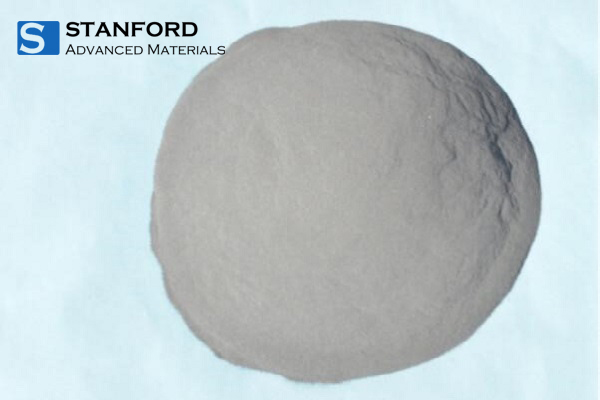
From artificial joints to turbine components guarding aircraft engines, a material called CoCrMo alloy powder plays an indispensable role.
What is CoCrMo Alloy Powder?
CoCrMo alloy powder, or cobalt-chromium-molybdenum alloy powder, is a type of Stellite alloy. And it offers excellent mechanical properties, wear and corrosion resistance, and biocompatibility.
Composition of CoCrMo Alloy Powder
CoCrMo alloy powder is a high-performance metal material based on cobalt, with added elements like chromium, molybdenum, carbon, and silicon. It can be used for both industrial and medical purposes. There are slight differences in the elemental composition of CoCrMo alloy powder intended for industrial versus medical applications.
|
Element
|
Medical Grade Content
|
Industrial Grade Content
|
Role
|
|
Co
|
58-62%
|
56-64%
|
Matrix material, provides toughness
|
|
Cr
|
28-30%
|
27-30%
|
Forms a protective Cr₂O₃ oxide film for corrosion resistance
|
|
Mo
|
5.5-6.5%
|
5-7%
|
Solid solution strengthening, improves high-temperature stability
|
|
C
|
≤ 0.25%
|
≤ 0.35%
|
Carbide precipitation enhances hardness
|
This composition design gives the alloy outstanding overall performance, particularly in biocompatibility and mechanical properties.
Applications of CoCrMo Alloy Powder
|
Field
|
Application
|
|
Medical Implants
|
Hip/Knee Joint Prostheses
|
|
Dental Crowns, Bridges, Implants
|
|
Minimally Invasive Surgical Instruments, e.g., Vascular Stents
|
|
Aerospace
|
Turbine Blade Seals
|
|
Combustor Liners
|
|
Lightweight Structural Components, e.g., Satellite Frames
|
|
Industrial Sector
|
Injection Molds
|
|
Wear-Resistant Coatings, e.g., Sealing Rings
|
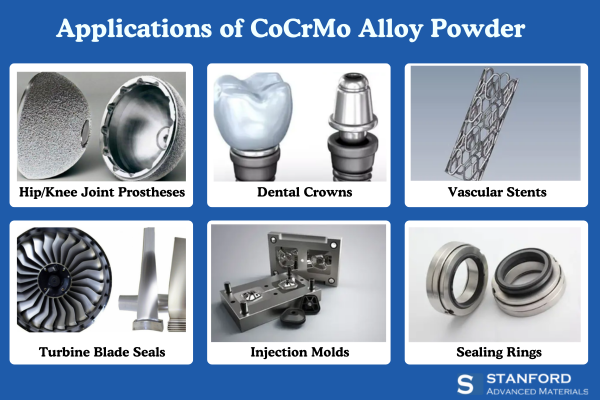
CoCrMo alloy is a top choice for manufacturing artificial joints, such as hip and knee prostheses, accounting for about 60% of applications in this field. Dental restorations made from CoCrMo alloy resist corrosion from saliva and food, and integrate well with surrounding tissues.
CoCrMo Alloy Powder Production Processes
CoCrMo alloy powder is typically produced using advanced techniques like Plasma Rotating Electrode Process (PREP), Gas Atomization (GA), and Mechanical Alloying (MA). Different processes yield powders with varying particle sizes and morphologies. Our previous articles have detailed these processes, so we won't repeat them here. Let's directly compare the differences in CoCrMo powder produced by these methods:
|
Production Process
|
Particle Size Range
|
Sphericity
|
Oxygen Content
|
Purity
|
|
Gas Atomization (GA)
|
15 - 150 µm
|
≥ 85%
|
150 - 500 ppm
|
High
|
|
Plasma Rotating Electrode (PREP)
|
50 - 150 µm
|
≥ 90%
|
≤ 100 ppm
|
Very High
|
|
Mechanical Alloying (MA)
|
1 - 200 µm
|
≤ 70%
|
≥ 1000 ppm
|
Low
|
- Gas Atomization (GA) is currently the most widely used process, and it offers a strong overall balance of cost and performance. This method produces powder with good sphericity and well-controlled oxygen content. Then the particle size range meets mainstream needs, from 3D printing to thermal spraying. So GA serves as the primary method for commercial CoCrMo alloy powder production.
- Plasma Rotating Electrode Process (PREP) achieves the highest standard in powder purity. During production, the alloy droplets do not contact any refractory materials. On the contrary, they form under high vacuum through centrifugal force. The resulting powder, thence, has extremely low oxygen content, very high sphericity, and almost no foreign inclusions. These qualities make it ideal for critical aircraft engine components and long-term medical implants. These applications demand extreme fatigue performance and purity.
- Mechanical Alloying (MA) follows a completely different approach from the other methods. It uses high-energy ball milling to produce powder. The resulting powder is characterized by irregular shapes and significantly higher oxygen content. However, this process enables solid-state alloying, which conventional melting methods cannot achieve. Because of this unique capability, it holds a specific place in certain high-temperature enhancement applications.
What are the Core Advantages of CoCrMo Alloy Powder?
The performance advantages of CoCrMo alloy lie mainly in three areas: mechanical properties, corrosion resistance, and biocompatibility.
1. Excellent Mechanical Properties
After heat treatment, CoCrMo powder can reach a very high tensile strength, about 1260 ± 100 MPa. This is nearly double the strength of 316L stainless steel. Furthermore, in forming processes like 3D printing using LPBF technology combined with solution and annealing treatments, the columnar grains of CoCrMo printed parts can be transformed into equiaxed grains. This increases elongation to over 20% and makes properties more uniform.
2. Outstanding Corrosion Resistance
Chromium in the CoCrMo alloy powder forms a dense, protective film on the surface, called Cr₂O₃. This film acts like a strong shield, and it stops corrosive substances from reaching the inside of the alloy. In simulated body fluid, its corrosion rate is very low, less than 0.01 mm per year. This is much lower than 316L stainless steel, which corrodes at 0.05 mm per year.
Molybdenum also helps. It greatly improves resistance to pitting corrosion. This ensures the material stays intact even in harsh conditions.
3. Superior Biocompatibility
CoCrMo alloy is certified by ISO 10993 for biocompatibility. Allergic reactions in clinical use are rare, occurring in less than 0.3% of cases. Apart from it, its surface has a Zeta potential of -25mV. This helps reduce non-specific protein adsorption.
Advantage Analysis:
Let's compare alloyed CoCrMo with similar materials to better understand its advantages.
|
Dimension
|
Vs. Material
|
Performance Advantage
|
|
Medical Field
|
vs. Titanium Alloy
|
Wear resistance is 3 times higher
|
|
vs. Stainless Steel
|
Better biocompatibility, very low allergy risk
|
|
High-Temperature Environment
|
vs. Nickel-Based Alloy (Inconel 718)
|
20% better oxidation resistance at 1000°C
|
|
Manufacturing Adaptability
|
vs. Wrought Cobalt-Based Alloy (CoNiCrMo)
|
3D printing accuracy reaches ±0.02mm, enabling complex structures
|
Of course, we must also consider the disadvantages of CoCrMo for a comprehensive understanding.
|
Dimension
|
Vs. Material
|
Performance Disadvantage
|
|
Cost
|
vs. Stainless Steel
|
Material cost is 5-8 times higher
|
|
Weight
|
vs. Titanium Alloy
|
Higher density, limiting use in weight-sensitive applications
|
|
Process Difficulty
|
vs. Common Steels
|
Prone to work hardening during cold working, requires special tooling, increasing processing costs by ~30%
|
Conclusion
CoCrMo alloy powder offers outstanding mechanical properties, exceptional corrosion resistance, and reliable biocompatibility. It performs excellently in highly demanding fields such as medical, aerospace, and high-end industrial applications. Despite challenges in cost and processing, it provides irreplaceable value for high-end applications. Stanford Advanced Materials (SAM) is a professional supplier of high-performance alloy powders. Visit SAM to learn more.